

Description
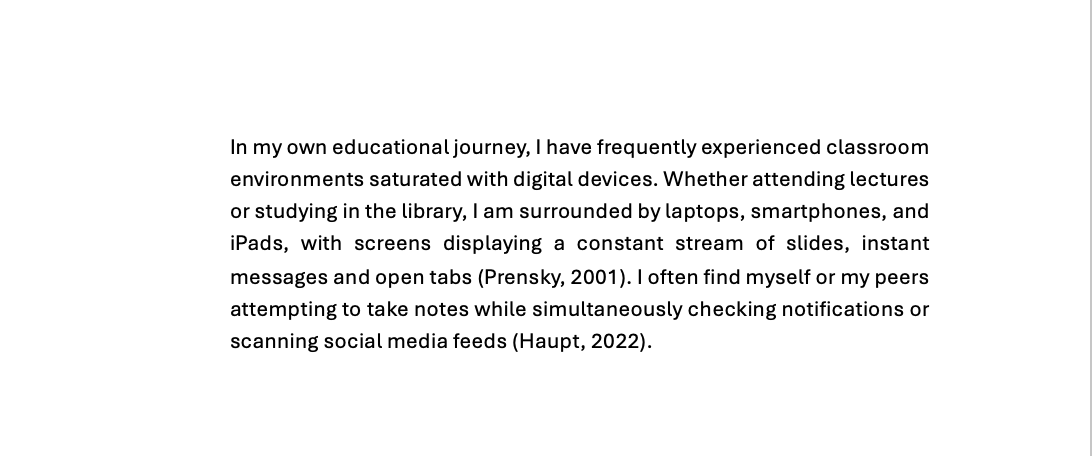
Throughout my educational journey, digital technology has become a constant part of my learning environment. In lectures, classrooms and libraries, I regularly use laptops, smartphones and online learning platforms to access course materials, take notes and communicate with peers. However, I have also noticed how easily these devices divide my attention. During study sessions, I often move between lecture content, notifications, messages and unrelated tabs. What initially feels productive can quickly become a cycle of distraction that affects how deeply I engage with learning.
Changes
Research citations were removed from the Description. The original Description introduced Prensky (2001) and Haupt (2022) immediately. The feedback specifically recommended making this section more focused on what actually happened before introducing research. The description is now based on the personal experience itself.
Feelings
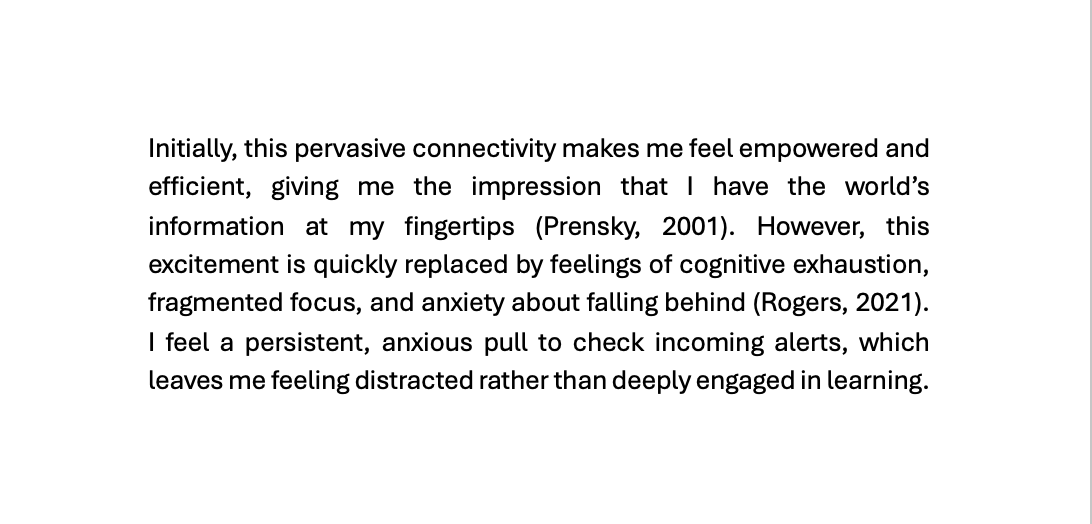
Initially, having constant access to technology makes me feel capable and efficient. I appreciate being able to find information quickly, communicate with others and complete university work from almost anywhere. However, I have increasingly recognised feelings of cognitive exhaustion and anxiety when I am constantly connected. I sometimes feel an almost automatic urge to check notifications, even when I know I need to concentrate. This has made me question whether my use of technology is genuinely supporting my learning or simply making me feel busy. As a future teacher, this also concerns me because students may experience the same tension between the educational benefits of technology and its capacity to distract them.
Changes
The personal reflection has been expanded. The feedback asked for greater depth about how the experience personally affected me. Rather than only identifying “cognitive exhaustion” and “anxiety,” this version explains what those feelings cause me to question and connects them to my developing teacher identity.
Evaluation
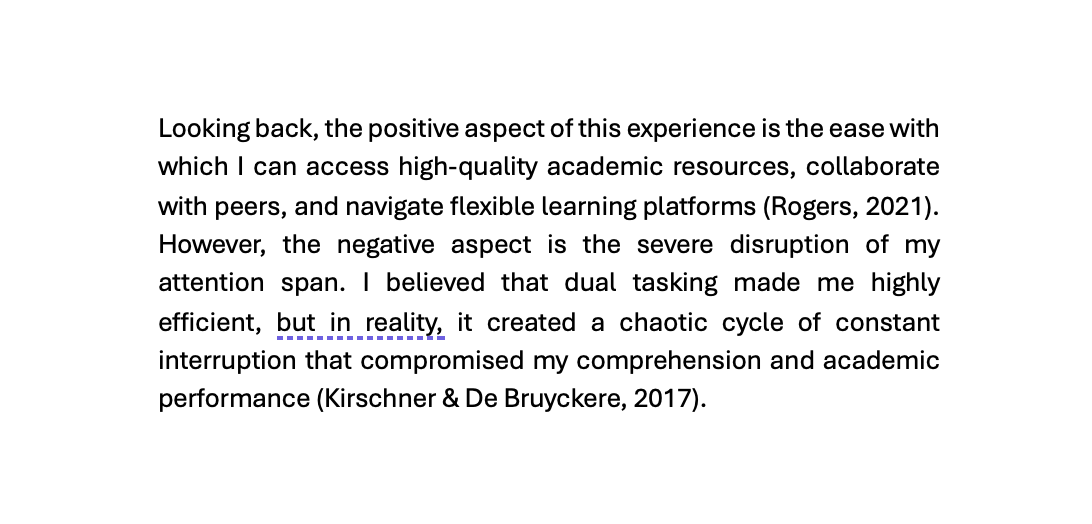
Digital technology has provided significant benefits to my education, including access to academic resources, collaboration and flexible learning opportunities (Rogers, 2021). These experiences demonstrate how technology can make education more accessible and connected. However, I have also realised that attempting to multitask often compromises my concentration and comprehension. Kirschner and De Bruyckere (2017) argue that people do not effectively multitask but instead rapidly switch between tasks, increasing cognitive load and reducing learning effectiveness. Therefore, my experience with technology has involved both increased educational opportunity and increased potential for distraction.
Changes
This section has been tightened so that the positive and negative aspects are clearly balanced. Research is used here rather than being concentrated in the earlier description and feelings stages.
Analysis
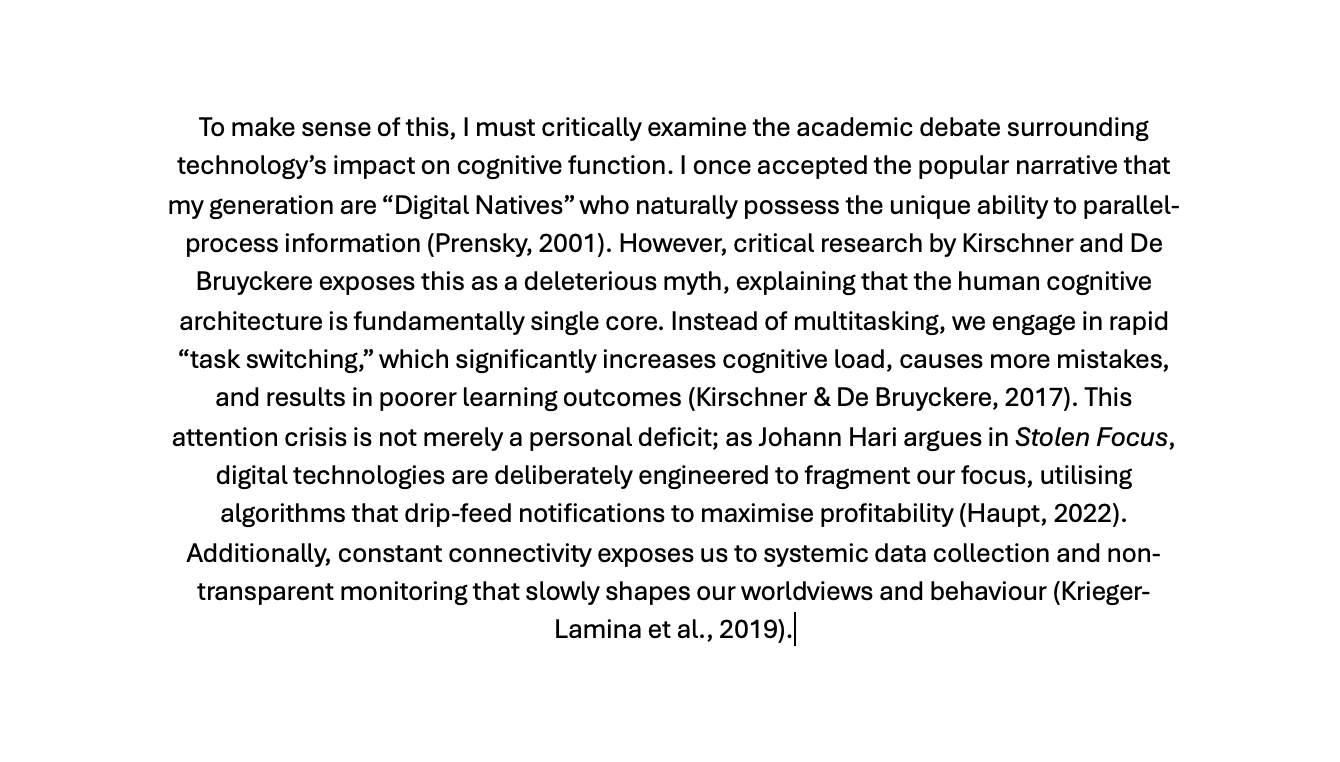
My experience challenges the assumption that being a “digital native” automatically makes someone an effective user of technology (Prensky, 2001). Simply growing up surrounded by digital devices does not guarantee digital literacy or an ability to manage competing information effectively (Kirschner & De Bruyckere, 2017). Digital environments can also be deliberately designed to capture and retain attention through notifications and other features (Haupt, 2022).
This matters for teachers because technology use is a pedagogical issue, not simply a technical one. Digital tools can enhance collaboration and learning, but their effectiveness depends on how they are implemented (Timotheou et al., 2023). Teachers therefore need to explicitly teach students how to use technology critically, intentionally and responsibly rather than assuming students already possess these skills.
Changes
[CHANGE: This is one of the major revisions. The feedback asked for more critical analysis explaining why the impacts matter for students and teachers. The original reflection focused heavily on cognitive function and digital distraction; the revised version takes the next analytical step by explaining the pedagogical implication.]
Conclusion
I now understand that digital technology is neither inherently beneficial nor harmful to education. Its impact depends on how it is used. Effective digital learning requires intentional choices that balance access and collaboration with concentration, critical thinking and digital wellbeing.
Changes
The conclusion has been made more concise and directly answers the driving question about how digital technology affects teachers and education.
Action Plan
Moving forward, I will silence notifications and close unrelated tabs during focused study. In my future practice, I will establish clear purposes and boundaries for technology use rather than incorporating digital tools simply because they are available. I will also model responsible digital habits and help students develop the critical digital literacy required to recognise when technology supports learning and when it becomes a distraction.
Changes
The original action plan concentrated mainly on my own digital minimalism. The revised action plan retains this but extends it to specific actions I can take as a future teacher, making the reflection more relevant to my professional practice.
Create Your Own Website With Webador